What is Outcome Owl?
A business process observability platform. It captures events across every system a process touches (an order placed, a claim submitted, a loan advancing), links them into end-to-end chains, and reports where each stands, which are stalled, and what value is at risk.
How is it different from process mining or a BI dashboard?
Process-mining tools need a clean, structured event log and a data-modeling project before they show anything; a dashboard shows metrics you already defined. Outcome Owl takes one row per step from any system that can send one, keeps imperfect rows visible until they are fixed, derives the end-to-end chain for you, and shows individual live instances, not just aggregate charts.
Couldn't we build this ourselves with AI?
You could build the dashboard; AI coding tools make a first version fast. The work is underneath it, for as long as you use it: steps that arrive out of order, corrected records sent again, rows with errors that must be rechecked rather than dropped, an audit trail, and the day its builder moves on. Outcome Owl runs and secures your dedicated deployment for you. If a tracker for one system is all you need, building it may be the better choice.
How does my data get in?
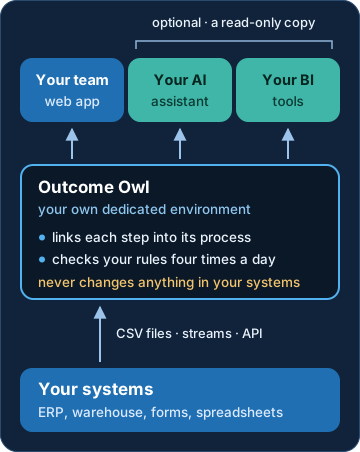
Start with a CSV file: one row for each step that happened, exported from the systems you already use and uploaded in the browser or dropped into cloud storage. Kafka streaming, a REST API and OpenTelemetry traces work too, with no agents to install. Late, out-of-order or incomplete rows are staged and shown with their reason until they are fixed.
What doesn't Outcome Owl do?
It does not plan: it does not work out what to buy or build from a bill of materials and a schedule. It does not change anything in your systems. It does not send email or chat alerts; flagged items wait in the web app, where your AI assistant can check them too. And it reads one row for each step that happened, not report layouts.
Can it tell my team what to do next?
No. Outcome Owl reports facts: which orders, claims or cases are late, stuck or breaking a rule, and what changed. Deciding what to do next, such as what to buy or build, stays with your people, your planning system, or an AI agent you run.
Does it send alerts?
Not by email or chat. Outcome Owl checks your rules four times a day and flags what breaks them in the web app, where your team sees them. Your AI assistant can check the same flags, and an agent you run can turn them into emails or tickets.
Can my AI assistant or autonomous agents use it?
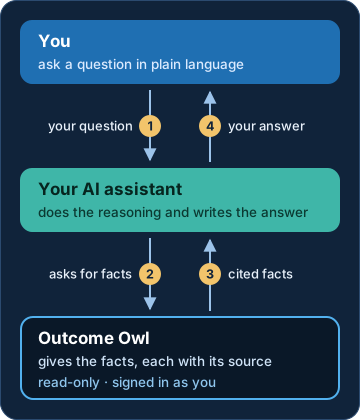
Yes, as an option: your operations are exposed as typed, read-only tools over the Model Context Protocol (MCP), reading a read-only copy of your data. Every figure is cited to the query that produced it, and the surface reports facts, never judgments.
Where does my data live, and is it read-only?
Each customer gets its own database, storage and compute in AWS, shared with no other customer. Outcome Owl never changes anything in your systems: it surfaces insight, never acts on your behalf, and its AI connection is read-only. It is engineered against a SOC 2 Type 2 readiness program but holds no SOC 2 report today.